Introduction
I've watched countless contractors pay for materials that never arrived on site.
Not because their finance teams are incompetent. Because the systems they're using make it nearly impossible to catch these mistakes before the money leaves the bank.
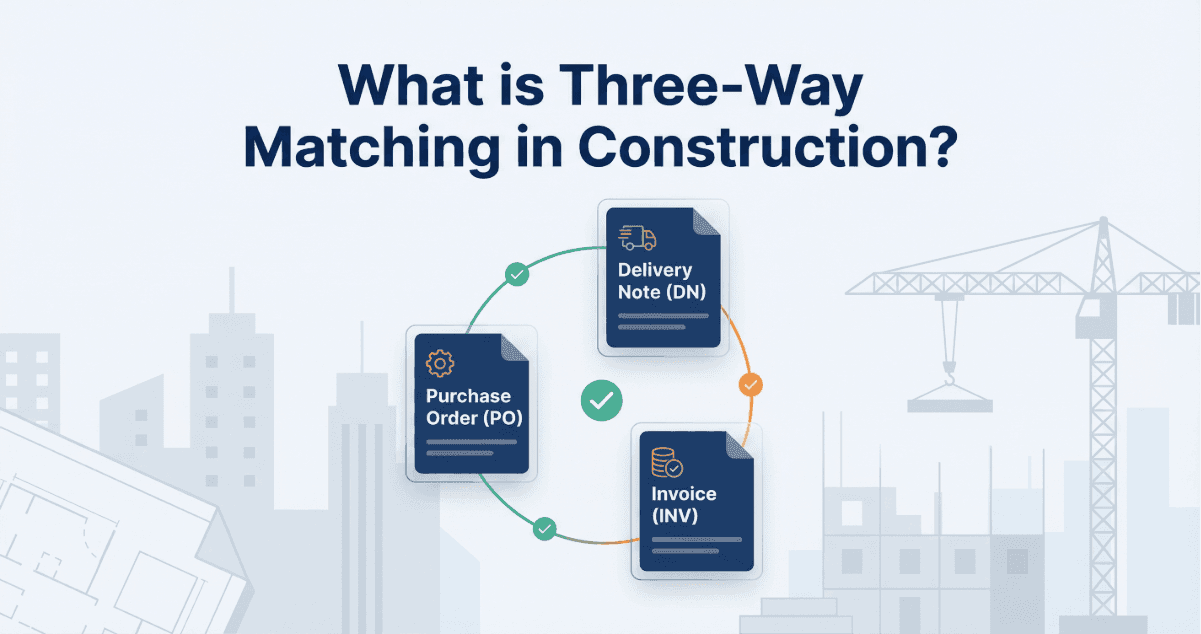
Three way matching is the control that should prevent this. You compare three documents before paying an invoice: the purchase order, the delivery note, and the invoice itself. Match all three, pay the invoice. Something doesn't line up, stop and investigate.
Simple in theory. A nightmare in practice if you're still doing it manually.
I spent years at Milestone processing hundreds of invoices every month. When you're running on tight margins, you can't afford to overpay by even 1%. But that's exactly what happens when your delivery notes are lost in WhatsApp threads and your purchase orders are scattered across three different spreadsheets.
This guide explains how three way matching actually works in construction, why most companies struggle with it, and how you can fix it without adding more admin burden to your already stretched finance team.
What is Three Way Matching?
Three way matching compares three documents before you approve a supplier invoice:
- Purchase Order What you ordered
- Delivery Note What actually arrived on site
- Invoice What the supplier is billing you for
The logic is straightforward. You only pay for what you ordered AND received, at the price you agreed.
Here's how the three documents connect:
Purchase Order Your procurement team creates this. It shows what items you ordered, how many, the agreed price, and when you need them.
Delivery Note Your site team confirms this when goods arrive. It records what was actually delivered, the quantity received, the condition, and the date.
Invoice The supplier sends this. It shows what they're charging you for, the quantities they say they delivered, and the prices.
When all three match, you pay. When they don't, you've caught a problem before it costs you money.
Why Three Way Matching Matters in Construction
Construction is uniquely difficult when it comes to invoice matching. Here's why.
You're Processing Hundreds of Orders Every Month
A typical contractor processes 300 to 500 purchase orders monthly across different projects. Each order can generate multiple deliveries and invoices. If you don't have a systematic way to match these, errors slip through.
I've seen it happen. A £15 discrepancy per invoice doesn't sound like much. Multiply that by 400 invoices and you've just lost £6,000 that month. Every month.
Materials Rarely Arrive in One Go
Construction materials don't show up in neat, complete deliveries. Concrete comes in multiple pours. Timber arrives in batches. Plant hire runs across variable periods.
Each partial delivery needs tracking against the original order. Miss one and you end up paying for materials you never received.
Site Conditions Change Constantly
What you order in week one isn't always what you need by week four. Design changes, variations, weather delays. Quantities shift.
Three way matching catches when suppliers invoice for the original order but only delivered what actually got used. Without it, you're paying for materials that got cancelled or reduced.
Three Different People Handle Each Transaction
The person ordering materials is not the person receiving them. And neither of them is the person paying the invoice.
Site manager orders, site operative receives, accounts team pays. Three way matching creates accountability across these handoffs. Otherwise, invoices get approved based on trust and assumption rather than evidence.
Your Margins Can't Absorb These Losses
Construction runs on thin margins. 2% to 5% net profit is typical according to Build UK industry benchmarks.
Overpay on invoices by even 1% and you've wiped out half your project profit. Three way matching protects those margins.
Common Problems Three Way Matching Prevents
Here are the actual problems you'll catch when you implement proper three way matching.
Duplicate Invoices
Suppliers send the same invoice twice. Sometimes it's an honest mistake, sometimes it's a system error on their end, sometimes it's deliberate.
Without matching to your delivery records, you pay both. I've seen it happen.
Quantity Discrepancies
Invoice says 500 bricks. Delivery note says 450 arrived. You just overpaid by 10%.
This happens constantly. Driver can't fit the full load. Damaged goods get rejected on site. Supplier ships short and hopes you won't notice.
Price Variations
Purchase order shows £12.50 per bag of cement. Invoice charges £13.75.
One bag, not a big deal. 200 bags across 50 orders this month and you've just lost £250. Small differences across hundreds of line items add up faster than you think.
Paying for Goods You Never Received
Invoice arrives for materials that never made it to site.
Lost in transit. Delivered to the wrong project. Delivered to the right project but signed for by someone who doesn't work for you. Or simply never dispatched and the supplier is chancing their arm.
Without a signed delivery note from your team, you have no proof either way.
Incorrect Project Coding
Materials ordered for one project, invoiced against another.
Your cost reports become meaningless. You think Project A is profitable and Project B is losing money. Reality is the opposite. You make decisions based on wrong information.
The Manual Three Way Matching Process
Most construction firms still do this manually. Here's what that looks like in practice.
Step 1: Invoice Arrives
Supplier sends an invoice by email or post. Someone in accounts logs it and assigns it to a project.
Step 2: Find the Purchase Order
Accounts team searches for the corresponding PO. This means digging through email chains, shared drives, or a spreadsheet log.
If you're lucky, someone filed it properly. If you're not, you're searching "cement supplier March" and hoping something comes up.
Step 3: Track Down the Delivery Note
Now you need proof the goods actually arrived.
This means chasing site teams for signed delivery notes. Usually that's a scanned photo on WhatsApp. Sometimes it's physical paperwork that needs posting back to the office. Often it's just... gone.
"Yeah, we got that delivery mate, I'll find the note later."
Later never comes.
Step 4: Compare All Three Documents
Assuming you've actually got all three documents, someone sits and manually compares:
Do the items match? Do the quantities match? Do the prices match? Is the delivery note signed and dated?
This takes 15 to 30 minutes per invoice. More if there are discrepancies.
Step 5: Resolve Discrepancies
Something doesn't match. Now the real work starts.
Calling suppliers. Chasing site managers. Digging through old records trying to work out what actually happened three weeks ago.
Step 6: Approve or Query
Finally, once everything matches or you've resolved the discrepancies, you approve the invoice for payment or send a formal query to the supplier.
Why Manual Matching Doesn't Work
I ran this process for years. It doesn't scale and it's full of holes.
Each invoice takes 15 to 30 minutes to match. When you're processing 400 invoices a month, that's 100 to 200 hours of work. Every month.
Different people apply different standards. One person queries every £5 variance. Another person waves through anything under £50. You have no consistency.
Delivery notes go missing constantly. Site teams are busy. Paperwork is not their priority. If the system relies on them scanning and emailing delivery notes, half of them won't make it back.
There's no audit trail. Good luck proving what was checked and when. If a dispute comes up six months later, you're relying on someone's memory.
Month end is chaos. Everyone scrambles to clear the backlog. Invoices get approved that shouldn't be, just to hit payment runs.
Automated Three Way Matching
Proper construction procurement software automates this entire process. Here's how.
Digital Purchase Orders
Every order gets created in the system with full detail. Quantities, prices, specifications, project codes. Everything.
No more hunting for paperwork. The PO exists digitally from the moment it's raised.
Mobile Delivery Confirmation
Goods arrive on site. The operative pulls out their phone and confirms receipt right there.
They check off what was delivered against the original PO. Record actual quantities. Flag anything damaged or missing. Take photos if needed. Add notes.
Takes 2 minutes. Creates a digital delivery note instantly, linked to the purchase order.
No scanning. No WhatsApp. No lost paperwork.
AI Powered Invoice Processing
Supplier sends an invoice by email or PDF. The system extracts the line items, quantities, and prices automatically.
Then it matches the invoice to the correct purchase order, compares quantities to what was actually delivered, checks prices against what you agreed, and flags anything that doesn't line up.
No manual data entry. No cross referencing spreadsheets.
You Only Look at Exceptions
Instead of checking every invoice, your team only reviews the ones with problems.
Full match? System approves it automatically or queues it for batch approval.
Minor variance? Flagged for quick review. Maybe the price is 2% different. You decide if that's acceptable or worth querying.
Major discrepancy? Blocked completely until resolved. Like when they've invoiced you for something that was never delivered.
This cuts invoice processing time from 15 to 30 minutes down to under 3 minutes. For invoices with no issues, it's zero minutes because the system handles it.
What to Look for in Three Way Matching Software
If you're evaluating construction procurement software, here's what actually matters.
Mobile Delivery Confirmation
Site teams need to confirm deliveries on their phones. Not on a desktop back at the office. On their phones, on site, when the delivery happens.
If the system requires desktop access or any manual paperwork, your site teams won't use it. Your delivery records will be incomplete and you're back to chasing WhatsApp messages.
Automatic Invoice Capture
The system should extract invoice data automatically using OCR and AI. Line items, quantities, prices, everything.
If you're still manually keying in every line item, you haven't actually solved the problem. You've just moved it to a different spreadsheet.
Intelligent Matching Logic
Construction is messy. Your software needs to handle that.
Partial deliveries against a single purchase order. Multiple invoices per PO. Tolerance thresholds so you're not manually reviewing every £2 variance. Unit of measure conversions because suppliers don't all invoice in the same units you order in.
If the system can't handle this complexity, it will create more work, not less.
Clear Exception Handling
When an invoice doesn't match, the system needs to show you exactly what doesn't match and why.
Not just "discrepancy found." That's useless. You need to see: invoice quantity is 450, delivered quantity was 400, variance is 50 units, value £275.
Your team needs to resolve problems quickly. If they're spending 20 minutes just working out what the problem is, the software isn't helping.
Complete Audit Trail
Every match, every approval, every query gets logged with timestamps and user details.
This matters for internal controls. It matters for audits. It matters when suppliers dispute something six months later and you need to prove exactly what was delivered and when you approved it.
RICS guidance on procurement specifically calls out the importance of maintaining clear documentation throughout the procurement process. Audit trails give you that.
Supplier Query Management
When you challenge an invoice, the system should track the query, the supplier response, and the resolution.
No more email threads that get buried. No more "I'm sure we queried that months ago but I can't find the email." Everything documented in one place.
The Business Impact of Automated Matching
Here's what actually changes when you implement this properly.
Invoice processing drops from 15 to 30 minutes to under 3 minutes. That's an 80% reduction in time spent. For a team processing 400 invoices a month, you've just freed up 100 hours of work.
Payment errors drop by 90%. Duplicate payments, overpayments, paying for goods you never received. Most of these disappear because the system catches them automatically.
Month end close gets 2 to 3 days faster. You're not scrambling to clear a backlog of unmatched invoices. Most are already approved automatically. You only focus on exceptions.
Invoice disputes with suppliers drop by 75%. When you can instantly show them the delivery note, the purchase order, and exactly what doesn't match, disputes get resolved faster or don't happen in the first place.
Your finance team gets 30% to 40% of their capacity back. Time that was spent chasing delivery notes and cross referencing spreadsheets now goes into actually managing the business finances.
Beyond the numbers, there's a bigger shift. Your finance team stops being reactive. Stops chasing. Stops firefighting.
They move to proactive financial control. They can see problems before they become expensive. They can actually analyse spending patterns instead of just processing invoices.
Three Way Matching vs Two Way Matching
Some businesses use two way matching. They compare the purchase order and the invoice, skip the delivery confirmation.
When Two Way Matching Works
Low value purchases where the risk is minimal. Services rather than physical goods. Suppliers you've worked with for 10 years and trust completely.
Why Construction Needs Three Way
Two way matching doesn't work in construction. Here's why.
Materials get delivered to the wrong site. I've seen it dozens of times. Supplier sends 200 bags of cement to Project A. You ordered them for Project B. Without a delivery confirmation from your site team, you have no way to catch this.
Quantities vary constantly. You order 500 bricks, 450 turn up. Driver couldn't fit them all. Without checking the delivery note against the invoice, you pay for 500.
Partial deliveries are standard in construction. Concrete comes in multiple pours. Timber in batches. Plant hire across variable periods. You need to track what's actually been delivered against the full order.
Site conditions cause rejections. Materials arrive damaged. Wrong specification. Not needed anymore because of a design change. Your site team rejects them. Supplier invoices anyway.
The delivery confirmation is not optional. Without it, you're trusting that everything ordered was received correctly. On a busy construction site with multiple deliveries every day, that's not a safe assumption.
Getting Started with Three Way Matching
If you're doing manual matching now, or no matching at all, here's how to fix it.
Audit What You're Actually Dealing With
Start by understanding the scale of the problem.
How many invoices are you processing each month? What's your current error rate? How many disputes with suppliers? How long does matching take per invoice? How often do delivery notes go missing?
You need real numbers, not guesses. Track it for a month.
Pick Your Quick Wins
Don't try to fix everything at once. Start with your highest volume suppliers. Or your most problematic categories where errors happen constantly.
These will show ROI fastest. Success here builds momentum for rolling it out wider.
Get Your Site Teams On Board
This only works if site teams confirm deliveries properly. If they don't use the system, you're back to chasing paperwork.
Involve them early. Show them why this matters. Make it as simple as possible. Mobile first. Minimal clicks. If it takes 30 seconds on their phone, they'll do it. If it requires forms and desktop access, they won't.
Set Tolerance Thresholds
Not every tiny variance needs manual review. You'll go mad.
Define what's acceptable. Quantities within 2%? Prices within £5? Whatever makes sense for your business.
This focuses your attention on actual problems, not trivial differences.
Measure and Improve
Track your processing times, error rates, dispute volumes. Month by month.
If processing times aren't dropping, work out why. If errors are still happening, find the pattern. Use the data to actually improve the process, not just to have dashboards.
Conclusion
Three way matching is basic financial control. You only pay for what you ordered and actually received, at the price you agreed.
Most contractors are still doing this manually. Chasing delivery notes. Cross referencing spreadsheets. Resolving discrepancies one invoice at a time. It takes hours and errors still slip through.
Automated matching software cuts processing time by 80% and eliminates most payment errors. For finance teams drowning in invoice admin, it's one of the fastest ways to get control back.
See Three Way Matching in Action
We built StoneRise to automate this entire process. Digital purchase orders, mobile delivery confirmation, AI powered invoice processing.
Our customers process invoices in under 3 minutes. Payment errors dropped by 90%.
If you want to see how it actually works, request a demo.
FAQ: Three Way Matching in Construction
What documents are used in three way matching?
Three documents: the purchase order showing what you ordered, the delivery note showing what actually arrived on site, and the supplier invoice showing what you're being charged. All three need to match before you approve payment.
How long does three way matching take?
Manually, 15 to 30 minutes per invoice. That includes finding the documents, comparing everything, and sorting out any discrepancies. Automated software cuts this to under 3 minutes. For invoices with no issues, it's instant.
What happens when the documents don't match?
The invoice gets flagged. Your finance team investigates. Is it a supplier error? Did your site team record the delivery wrong? Is it a legitimate variance because quantities changed?
You work it out, then either approve the corrected invoice or query it with the supplier.
Is three way matching required by law?
No, it's not a legal requirement. But it's standard practice for financial controls.
Most construction contracts expect it. ISO 9001 quality management certifications require evidence of systematic invoice verification. Auditors look for it.
If you're not doing it, you need a good explanation why.
Can three way matching be automated?
Yes. Proper procurement software handles it automatically.
Digital purchase orders, mobile delivery confirmation from site, AI extraction of invoice data. The system matches everything and flags exceptions. Reduces manual work by 80% or more.
Last updated: February 2026